
Today Petrol Price in Pakistan | Current Fuel Rates & Updates 2026
Today Petrol Price in Pakistan
Live & Auto-Updated Fuel Rates Table
| Fuel Type | Old Price | New Price (PKR) | Difference | Unit |
|---|---|---|---|---|
| Petrol (Super) | Rs. 336.15 | Rs. 336.03 | Rs. 0.12 | Per Liter |
| High-Speed Diesel (HSD) | Rs. 393.04 | Rs. 392.38 | Rs. 0.66 | Per Liter |
| Light-Speed Diesel (LSD) | Rs. 199.98 | Rs. 199.98 | Rs. 0.00 | Per Liter |
| Kerosene Oil | Rs. 282.19 | Rs. 233.71 | Rs. 48.48 | Per Liter |
| Liquefied Petroleum Gas (LPG) | Rs. 308.76 | Rs. 241.43 | Rs. 67.33 | Per Kg |
Fuel Expense Calculator
The increasing fuel prices affect almost every household and business in Pakistan. This is because every Pakistani has to consider the cost of commuting when they have to travel to the office, school, or buy groceries from the local market. As the petrol and diesel rates are revised regularly by the Oil and Gas Regulatory Authority (OGRA), it will not be beneficial for people to just know about the petrol prices. That’s why knowing today petrol price in Pakistan per litre or the price right now will be helpful to plan a commute.
Well, you don’t have to look for other trusted resources because this page will provide you with complete information about the latest official fuel prices announced by the Government of Pakistan. We will discuss the prices of petrol, High-Speed Diesel (HSD), kerosene oil, and Light Diesel Oil (LDO) in detail. In addition, you will also get to know how these prices are decided, petrol price history, factors which affect prices, and more. So keep reading!
Use Our Free Fuel Price Calculator to estimate your Fuel Cost
Every Pakistani estimates the average fuel cost when they are planning a new trip to the Northern areas in summer or anywhere else. To help people make the perfect budget without any guessing, we provided an accurate fuel cost calculator.
The working process of this calculator is simple.
However, you can also calculate fuel cost manually using these steps.
Exploring Petrol Prices in Pakistan
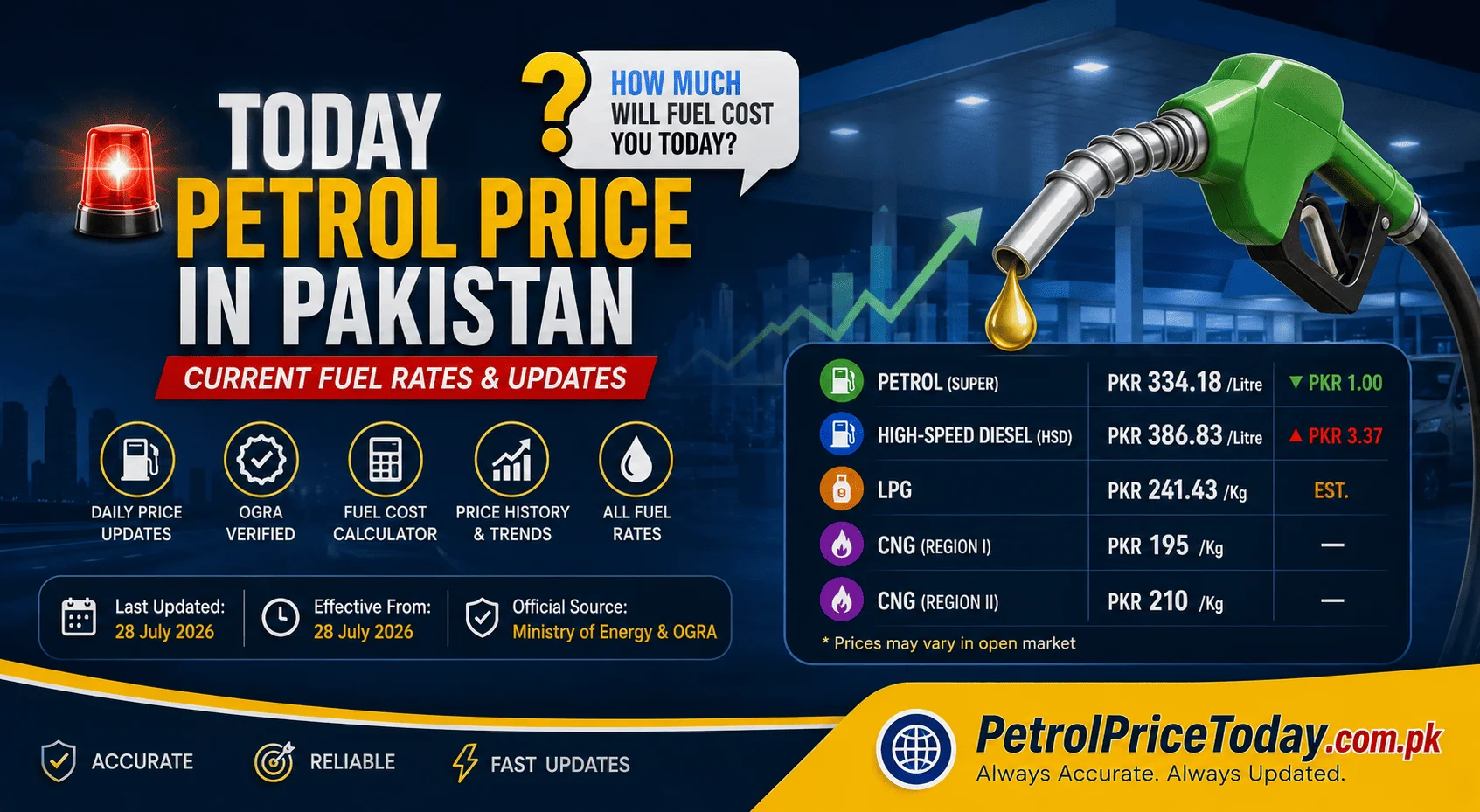
The primary fuel source for the Pakistanis is petrol, which is also known as motor gasoline or Motor Spirit (MS). By the latest OGRA notification, the current rate of Petrol in Pakistan is PKR 334.18 per litre. This rate is effective from 28 July, 2026.
For everyday commute, it is a widely used petroleum product as it helps to power millions of motorcycles and over 3 million registered cars. The 2024 report of the Global economy shows that petrol consumption was 180.85 thousand barrels per day. This amount is expected to increase to a huge level in 2026.
Details of Diesel Price in Pakistan Today
The current price of the High-Speed Diesel in Pakistan is PKR 386.83 per litre. This is PKR 3.37 more than the previous diesel rate, which was PKR 383.46. Changes in diesel prices affect the economy of Pakistan and daily life more than petrol. This is because it is used to run heavy agricultural machinery and heavy vehicles such as trucks, buses, and tractors across cities in Pakistan.
When the prices increase, the charges of transportation, construction, and delivery are also increased. Besides HSD diesel, some industries also use Light Diesel Oil. It is commonly used for industrial operations such as running small machinery and a few agricultural equipment. The price of LDO is 255.16 per litre in Pakistan.
Today’s Price of High Octane Petrol in Pakistan
High Octane petrol (Octane Euro 5) is also known as High Octane Blending Component (HOBC) or premium gas. This fuel is designed with a special formula that helps to reduce premature combustion or “engine knocking” under high pressure. However, only vehicles that have high-performance or turbocharged engines can benefit from this fuel.
In Pakistan, the ratings of high-octane petrol are usually 95 and above. This rating is enough to prevent engine knocking. According to the Pakistan State Oil, the prices of Octane Euro 5 are different in all cities.
In major cities such as Karachi, Lahore, Rawalpindi, and Faisalabad, the petrol price is PKR 350.00 per litre. At the same time, the petroleum price in Gilgit is PKR 356.00 per litre.
Today Prices of LPG and CNG
As petrol is difficult to afford for most people, they choose cheaper fuel alternatives, which include LPG and CNG. A detail of LPG and CNG prices is given below.
LPG Price in Pakistan
LPG is used for various purposes in Pakistan. For example,e people use it as a fuel for vehicles, and it is also used as a substitute for natural gas in areas where there is no access to pipeline natural gas. Similarly, the price of LPG is different in the domestic and commercial industries.
The table showing the current LPG price is given below:
| Cylinder Size | Current Price |
| 11.8 kg Domestic Cylinder | ~ PKR 2,849 |
| 45 kg Commercial Cylinder | ~ PKR 10,864 |
| Per kg LPG Rate | PKR 241.43 |
Note:
The prices of LPG in the open market may be higher than the official prices announced by OGRA. This increase in prices is because of distribution rates, local shortages, and retailer margins.
Current CNG Prices in Pakistan
There is no official fixed CNG price in Pakistan. This is because in most areas, the prices of CNG are not set by the government anywhere in Pakistan.
However, the change in prices depends on various factors, including the price of RLNG (Re-gasified Liquefied Natural Gas) and the supply of local gas. The table below shows the CNG prices in different regions.
Regional CNG Prices in Pakistan
| Region | Province(s) | CNG Price |
|---|---|---|
| Region I | Khyber Pukhtunkhwa, Baluchistan, Potohar region; Islamabad, Rawalpindi and Gujar Khan | PKR 308.76/kg |
| Region II | Sindh and Punjab excluding Potohar region | PKR 210.00/kg |
Exploring Petrol Price History & Trends in Pakistan
In the past decade, Pakistan has experienced a huge increase in the prices of petrol and other petroleum products. There are various national and international factors that affect these prices. Some of these include fluctuations in the international crude oil market, changes in the Pakistani Rupee’s exchange rate, government taxes, and petroleum fares.
During the past years, there were frequent multiple revisions in fuel prices. These revisions include sharp increases and temporary reductions in prices. However, political issues and changes of government were also one of the main reasons for the increase in prices.
Besides that, changes in the supply chain and in oil production by major exporting countries have also influenced fuel prices in the country.
Historical Petrol Prices in Pakistan
| Year | Approx. Petrol Price (Rs./Litre) | Key Driver |
|---|---|---|
| 2016 | ~62–65 | Global crude oil price crash (Brent below $30/barrel) |
| 2017 | ~85–90 | Gradual recovery in global crude oil prices |
| 2018 | ~95–100 | Rising international oil prices |
| 2019 | ~110–114 | Pakistani Rupee (PKR) depreciation |
| 2020 | ~74 (April low) → ~100+ (Year-end) | COVID-19 oil price crash followed by recovery |
| 2021 | ~106 → ~146 | Post-COVID economic recovery and higher fuel demand |
| 2022 | ~150 → ~249 | Russia–Ukraine war and PKR depreciation |
| 2023 | ~250 → ~305–331 | PKR lost around 40% of its value during the IMF program |
| 2024 | ~220–230 | Lower crude oil prices and a more stable PKR |
| 2025 | ~253 (January) → ~404 (December) | Higher petroleum levy and continued PKR pressure |
| 2026 (YTD) | ~300–380 | Regional tensions and reported Iran-related conflict |
Why Petrol Prices Change With Time in Pakistan?
As the prices of petrol are increasing, most of the people wonder why prices change after every few days. The answer depends on various factors such as international market conditions and domestic government policies.
Here are a few factors which determine the latest petrol prices:
International crude oil prices
International oil price is one of the biggest factors for frequent fuel price revision in Pakistan. This is because Pakistan imports a significant portion of petroleum from international markets.
That’s why, when benchmark crude prices such as Brent Crude or West Texas Intermediate (WTI) rise, the cost of importing fuel also increases. To accommodate these expenses the petrol and diesel prices increase across the country.
PKR/USD exchange rate
Crude oil is traded across the world in US Dollars. If the Pakistani rupee weakens against the Dollar, then Pakistan has to pay more for the same amount and quality of petrol to import.
However, sometimes the prices of oil increase in Pakistan even when the global crude oil prices are stable. This is because of the USD and PKR exchange rate changes.
Petroleum Development Levy (PDL)
The government impose tax which is charged on every litre of petrol or diesel sold in Pakistan. This tax is officially known as Petroleum Development Levy (PDL). The government changes its policies from time to time and changes the PDL value. The increase or decrease in the PDL directly affects the final retail fuel price.
Transportation and Distribution Costs
In the final fuel price, which is charged at petrol pumps, multiple expenses are also included.
Some of these factors include transportation, insurance, port handling, storage, and distribution expenses. If the transportation or shipping cost increases, it will also increase the landed cost of petroleum products before they even reach the fuel station across Pakistan.
Geopolitical events
Large-scale geopolitical events also have an impact on the global oil supply chain. When any conflict occurs in the oil-producing nations, or any disruption in oil transit channels like the Strait of Hormuz, it leads to increased prices for international crude oil. These changes ultimately affect the price of petrol in Pakistan.
Government Policy Decisions
The final retail fuel price is decided by the government after it reviews the OGRA’s pricing recommendation in detail. In addition, the government considers other factors such as petroleum taxes, government revenue goals, and any fuel subsidies.
Once the government analyzes all these factors, it suggests passing the full increase or decrease in international oil prices on to consumers or absorbing part of the cost.
Effect of Petrol Prices on Pakistan’s Economy
The effects of changes in fuel prices are not just limited to the pump or a few people’s businesses. Instead, changes in fuel prices will have a ripple effect on the economy of Pakistan. This is because it is used to power transportation, agriculture, manufacturing, and logistics in the country.
Here is how it affect the Pakistan’s economy:
Transportation Costs Increase
The cost of operation increases when the prices of petrol and diesel increase. The transport firms usually increase their fares to deal with the increased cost. As a consequence, there is an increase in the price that passengers pay to use the transport services.
Inflation and Higher Living Costs
Fuel prices impact the rate of inflation because almost all products need to be shipped before reaching consumers. Increased fuel expenses lead to increased costs of food, building materials, clothes, and many other things that people buy daily.
Impact on Agriculture
Diesel is widely used to run tractors, tube wells, harvesters, and other agricultural machinery. If the cost of diesel increases, then the cost of agriculture also increases. As a result, farmers can incur more costs on cultivation and transportation. This can ultimately result in higher prices for fruits, vegetables, wheat, and other agricultural commodities.
Business Operating Expenses
Most businesses use fuel for travel, transport of goods, and generators as an alternative source of power. Higher costs of fuel contribute to increased operational costs, especially for manufacturing, logistic and retail organizations. Small companies are the most affected since they have very little capital.
Adoption of Electric Vehicles
To save extra money from spending on petrol or diesel, most of the Pakistanis are now switching to EV bikes and electric cars. They are a suitable option for commuting as they consume less energy and are affordable. But buying EV bikes can be a costly investment, as good bikes are more than PKR 200,000 and also require a battery upgrade after a few months.
Government Revenue
The cost of fuel is also a source of income for the government through the Petroleum Development Levy (PDL) and any other related taxes. The income generated through the PDL and other taxes is used to fund government expenses and development programs.
Quick Fact:
According to the Pakistan Bureau of Statistics (PBS), changes in fuel prices are one of the major factors influencing the country’s inflation rate because transportation costs affect the prices of many goods and services.
How Petrol Prices are Decided?
Everyone wants to know who set today’s petrol price in Pakistan. Well, it is essential to know that the Oil and Gas Regulatory Authority (OGRA) does not set the final fuel prices on its own. However, it only recommends changes, and the final retail price is announced by the Federal Government after reviewing OGRA’s recommendations and several economic factors.
The pricing decision is made by following these factors:
- Firstly, the prices of international crude oil are monitored, particularly benchmark rates such as Brent Crude.
- OGRA then also calculates the total cost of purchasing, shipping, and insuring fuel before it reaches local refineries and storage facilities.
- Authorities also analyze the PKR/USD exchange rate.
- OGRA also analyzes the freight charges, dealer commissions, and oil marketing company margins. After that, it will prepare a pricing summary and submit its recommendations to the Federal Government.
- Then the finance department and Federal Government announce the new prices after reviewing OGRA’s recommendations, petroleum levies, taxes, and other fiscal considerations.
Do Petrol Prices Differ Across Pakistani Cities?
No. The official petrol price in Pakistan is the same across all major cities, including Karachi, Lahore, Islamabad, Rawalpindi, Faisalabad, Peshawar, Quetta, Multan, Hyderabad, and Sialkot. The Federal Government announces the retail price for the whole country, and all legal fuel stations must maintain the official price.
But sometimes, consumers living in remote areas or mountains may have to pay a different amount. These variations are usually due to additional transportation or logistics costs rather than different government pricing policies.
When purchasing petrol from legal gas stations managed by oil companies like PSO, APL, Shell Pakistan, or Gas & Oil Pakistan (GO), the price for petrol and diesel will be the same as what is stated officially by the government.
Comparison of Petrol, Diesel, LPG, and CNG Rates Per Litre
There are different types of petroleum products in Pakistan. Each type of fuel is used for different purposes and has different benefits. In addition, their prices also vary.
The table below compares the latest fuel prices in Pakistan.
Fuel Types, Current Prices & Common Uses
| Fuel Type | Current Price | Common Uses |
|---|---|---|
| Petrol (Motor Spirit) | PKR 334.18/Litre | Cars, motorcycles, small commercial vehicles |
| High-Speed Diesel (HSD) | PKR 386.83/Litre | Buses, trucks, tractors, generators |
| LPG | PKR 255.16/Kg* | Domestic use, commercial kitchens, LPG vehicles |
| CNG Region I | PKR 195/Kg | CNG-powered cars |
| CNG Region II | PKR 210/Kg | CNG-powered cars |
Why Trust Us for Fuel Price Updates?
Whenever you want to check the latest or today’s fuel price, you must visit our website for accurate information. This is because we provide updated fuel price information here, which removes the need to visit multiple sources.
Here is why you should trust us:
Daily Fuel Price Updates
Whenever the news of fuel price revision comes on Geo News or other TV channels, we immediately update our prices so that you can get accurate and updated information.
Authentic Information
No guessing or estimated values are provided on our website. Every detail of price increase or decrease is verified from the government notification. Moreover, we also check the data from the OGRA notifications and the Department of Energy.
Comprehensive Coverage
Besides just covering petrol prices, we also provide complete information about other petroleum products. These include diesel, LPG, CNG, HOBC, and kerosene. You can find the latest price updates, guides, and more.
Multiple-Device Friendly Website
We design our website for all devices such as Android, iOS, Windows, and MacOS. So that everyone can use it without facing any kind of hurdle. It is well optimized to be used on all devices.
Easy Calculation with Calculators
We also provide a cost calculator tool. This will help you to know how much your travel will cost on your trip to any destination. It helps to avoid last-minute budgeting issues.
Conclusion
In the economy of Pakistan, petrol prices have a major impact. The instability and daily increase of prices lead to inflation. However, this fluctuation in pricing occurs due to international crude oil rate changes, PKR/USD exchange rates, and political issues.
When the rates increase, the cost of transportation, food, agriculture, and other expenses also spike.
To deal with these challenges, you must remain updated with the latest fuel prices in Pakistan. You can take complete information related to fuel updates with accuracy from our site.